RTV-I Anti-Flashover Coating for Insulators
Product Description
Insulator contamination has been a problem since the birth of electrical power distribution. Salt spray, industrial pollutants, and even desert sand can lead to costly power interruptions due to arcing and flashover. While numerous attempts with other protective methods have had their limitations, there is a solution that utility maintenance engineers can rely on: RTV-I Anti-Flashover Coating for Insulators
RTV-I is a one-component silicone dispersion that cures to a tough high voltage insulator coating with very good electrical properties.
Special Features
- Long-term protection
- Very good resistance to weathering
- Excellent hydrophobic properties
- Outstanding tracking resistance
- Ready-to-use
Application
Protective silicone coating for porcelain, glass and epoxy insulators as well as for other high-voltage insulating equipment where surface contamination causes service problems.
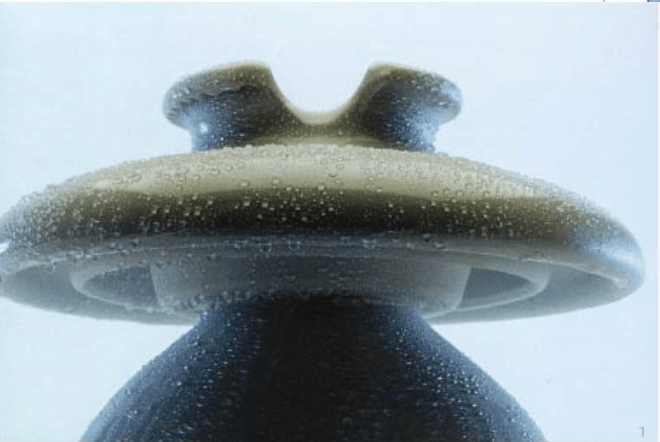
RTV coating forms a long-term hydrophobic surface. Thus it prevents the formation of wet conductive films and therefore the risk of pollution flashovers.
Processing
Surface pretreatment
The insulator surface to be coated should be clean and free of dust and grease. For cleaning the following operations are suggested:
a) Proper cleaning by using water and a suitable detergent might be sufficient,
b) Insulators that show an adhering pollution, such like cement, other mineral or chemical pollution layers should be cleaned by either “cob corn-“ or carbon dioxide blasting,
c) Any type of grease or fatty pollution is to be removed by using a suitable solvent like benzine or turpentine,
d) Residual contaminants should be removed by thoroughly wiping,
e) Finish the cleaning just before spraying RTV coating with Isopropanol or an equivalent alcohol.
Check carefully that there is no dirt or grease left before spraying!
In most cases it is not necessary to apply a primer before coating.
Coating Application
RTV coating is preferably applied by spraying. It can be applied by brushing or dipping as well. For spraying application, the airless process was found to be efficient. The following equipment settings were found to be suitable:
- Flat nozzle of 0.33 mm, 20°
- Settings of pressure output 50 – 150 bar
The spray gun should be moved evenly across the surface at a distance of about 30 – 50 cm. Due to the thixotropic properties of RTV coating, it is usually possible to apply the first layer with a good cover. A second layer can be applied after approximately 30 minutes.
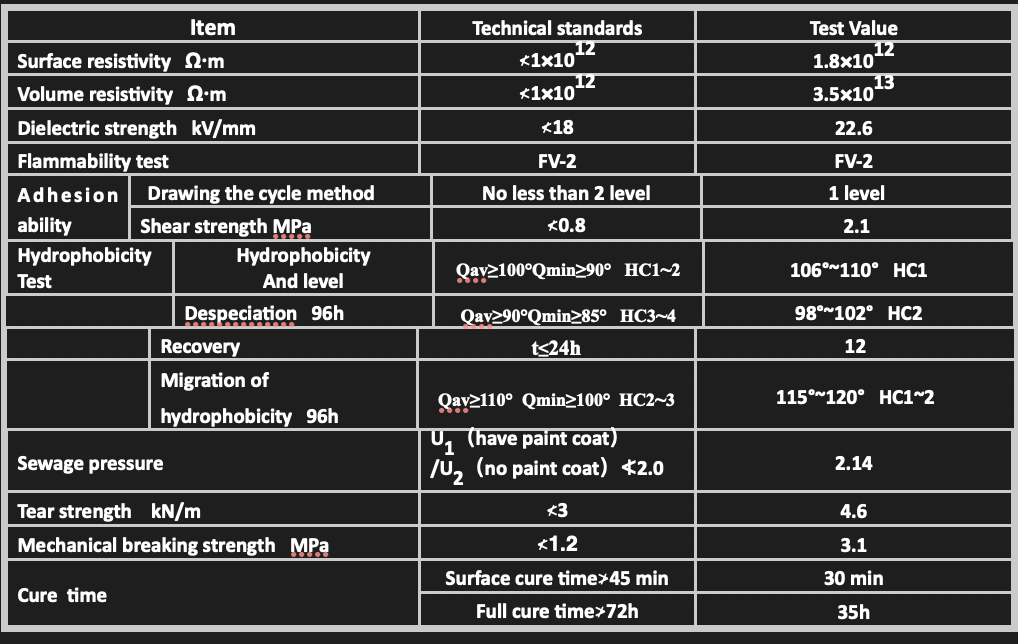
With two coats, usually a dry film thickness of about 0.5 mm will be achieved meaning a high protection for many years. Full cure is obtained in 35 hours after coating application depending on thickness and humidity.
Wind during spraying will cause overspray. Rain can damage the coating. In case of rain, please protect the job site or stop application.
About 2.0 kg of RTV coating is needed to coat each square meter of porcelain insulator surface with a dry film thickness of 0.5 mm. An additional amount of approximately 10% has to be calculated to take overspray into consideration. All spraying equipment should be cleaned with a nonpolar solvent (e. g. Xylene or White Spirit) immediately after use.
Storage
The ‘Best use before end’ date of each batch is shown on the product label.
Storage beyond the date specified on the label does not necessarily mean that the product is no longer usable. In this case however, the properties required for the intended use must be checked for quality assurance reasons.
Safety notes
Comprehensive instructions are given in the corresponding Material Safety Data Sheets.
 Union International Group Ltd - Company Profile and Services